
After living with a dog for a while, my biggest takeaway is this: stop trying to reason with it. Treat it like a reinforcement-learning (RL) agent.
A dog doesn’t understand “right” and “wrong.” It only understands which behavior leads to which consequence. Every single day it’s doing the same thing: probing its environment, then updating its policy to collect more reward and avoid punishment. Once that clicks, most training headaches turn out to be the same question:
What exactly are you rewarding, and what are you punishing?
The three sections below are all different faces of that one question.
1. Don’t be afraid of your dog
If you’re scared of your dog, sooner or later it will turn aggressive. That’s not superstition. It’s a loop that reinforces itself.
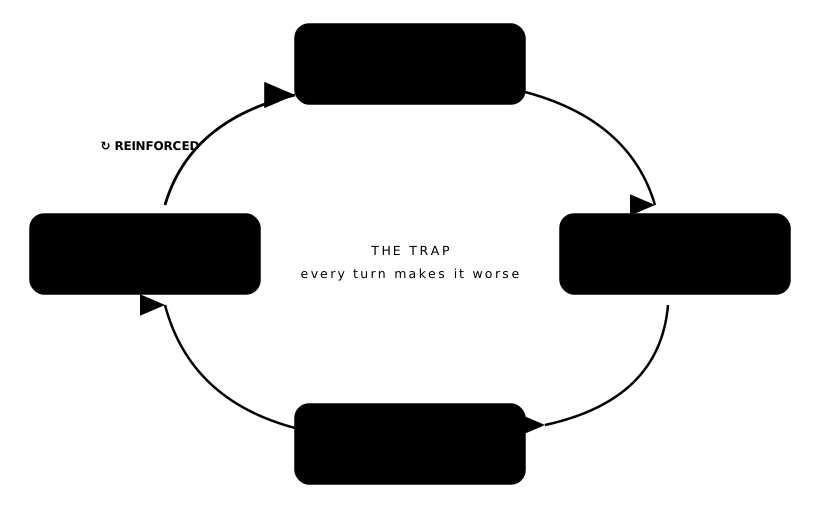
Break it down: you do something it dislikes (brushing teeth, clipping nails), and that’s the trigger. It grumbles first; pushed harder, it bares teeth and nips. You get scared and pull your hand back. In the dog’s eyes, it just learned a golden strategy: growling = the unpleasant thing stops.
Your retreat is the reward you handed it. And every time that reward fires, it hardens the “aggression works” policy by one notch. Grumbling escalates to barking, barking to a real bite. Step by step.
So the first thing, before you even get a dog, is to make sure nobody in the household is afraid of it. A little nervous? Do some desensitization at a shelter or pet store first. And when it does throw a threat signal, don’t withdraw your action (withdrawing is the reward). Just make it gentler, slower. What you want it to learn is the opposite lesson: aggression doesn’t work.
2. Don’t yell at your dog
The last point was about how your fear becomes a reward. This one is about how your punishment, most of the time, just switches off its ability to learn.
There are three layers to the logic:
1. A dog can’t learn while it’s afraid. Fear floods its brain; all it wants is to flee or freeze, with nothing left over to “figure out what to do next.”
2. In a world of pure punishment, the optimal policy is to do nothing. Picture it: do something wrong and you get punished, but do nothing and nothing happens. For a rational agent, the safest policy is to not move, not try, not explore. And no exploration means no learning.
3. An early-stage dog can’t tell which behavior you’re punishing. It struggles to pin the punishment to a specific action, and tends to attribute it to the whole environment, or even to you. The lesson it takes away isn’t “I shouldn’t do that,” it’s “this person / this place isn’t safe.” Once trust breaks that way, it’s basically unrecoverable.
Rewards, by contrast, increase the drive to explore. In RL, no exploration means no learning; the more willing your dog is to try things, the more you have to shape.
And rewards come in tiers. A whispered “good” and a chunk of boiled chicken are both “praise,” but their weights are worlds apart. Think of it as one axis:
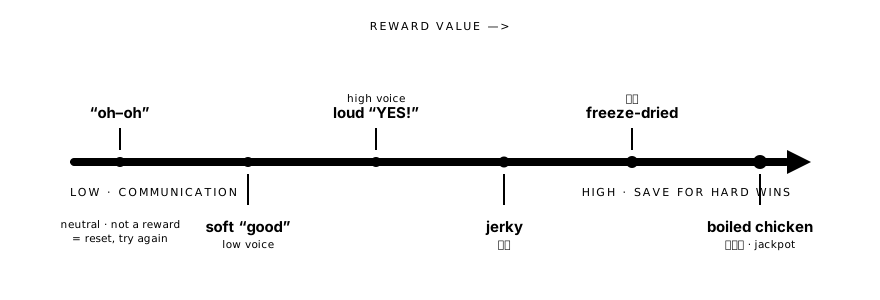
The rule is simple: use words for everyday little things, and save the high-value food for the hardest tasks (like an off-leash recall outdoors). Run top-tier treats for everything and their marginal value collapses fast.
That leftmost “oh–oh” deserves its own mention: it’s a neutral marker, not a punishment. It just means “that wasn’t it, try again,” with zero emotion attached. It gives the dog a “no worries, go again” signal so it keeps exploring.
The high/low voice has a clever property too: you physically can’t speak in a high, sing-song pitch while you’re angry. So the moment you can produce that talking-to-a-toddler pitch, you’ve proven to the dog “I’m not angry right now, no punishment.” Keep contrasting high-pitch = reward with low = interrupt, and the dog reads your emotional signal very quickly.
3. How to handle bad behavior
I don’t love the phrase “asserting dominance.” It’s too easily read as “punish and command at will.”
The key thing to remember is: a dog is a self-reinforcing creature. A bad behavior only needs to pay off once and it’ll grow on its own. So for bad behavior, the right response isn’t “punish.” It’s two moves:
- Interrupt: cut the behavior off before it completes and collects its reward, so it never gets to self-reinforce.
- No reward: don’t supply any consequence it wanted.
Note that neither of these is punishment. Emotionally, you stay calm.
The environment’s own rewards can be used as bonus rewards. The classic case is recall:
- Recall succeeds → drop the leash and let it go play. Freedom itself is a huge reward.
- Recall fails → calmly reel it back in. That’s an interrupt, not a lesson.
The critical part is that the signal must be clear: give the command once or twice, and if it doesn’t come, stop calling immediately. Otherwise you’re teaching it that “the command can be shouted eight times and it’s fine.” When you can reliably recall it, you dare to let it off leash; when it gets freedom often, its motivation to bolt actually drops. That’s a virtuous loop, and tolerating one disobeyed recall can be fatal.
The same principle transfers everywhere. Peeing in the wrong spot at home, for instance: don’t scold it at the wrong spot. Instead, interrupt → carry it to the right spot → reward it at the right spot. What you want to reward is “going in the right place,” not make it afraid of “going” itself. Leash work, sit-and-stay: the logic is identical. Get clear on what you’re interrupting and what you’re rewarding, and the rest is just repetition.
What to feed and how (kibble choices, boiled chicken, meal timing) is a whole other topic. I’ll write a dedicated post on it later. This one only covers using food as a reward signal.